Fuel Consumption
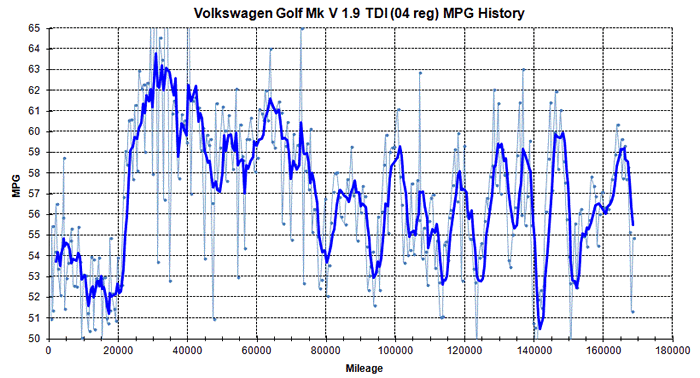
The graph below covers the car from new in June 2004 up until January 2016.
Fuel consumption is measured by recording the date, quantity of fuel added to fill the car's tank and the car's odometer reading at each visit to the filling station. This information is then entered into a spreadsheet periodically to produce the graph. Because of the inaccuracies of the method, instantaneous fuel consumption calculations (thin blue line) are unreliable and so a rolling average of the last 5 calculations (thick blue line) are plotted.
| Mileage (Date) | Description |
|---|---|
| 168,850 (Jan 2016) | Car's running great! Nothing to report. MPGs a little down as usual during the cooler winter months but engine runs great. |
| 159,500 (Nov 2014) | There was a problem: A sticking rear brake calliper! Fixed now and you can see that the Instantaneous MPG is pulling up the Average MPG. |
| 157,00 (Sep 2014) | Slight improvement.Pretty sure all is ok. |
| 155,100 (Jul 2014) | Is it wrong to be disappointed with 55mpg? Car is running great so I don't think anything is wrong. Not too worried. |
| 151,100 (Jan 2014) | Quite a dip. Car is running excellent though so I don't think anything is wrong. Combination of typical winter running (low ambient temperatures and heavy headlight/wipers/heating use). Also, quite a few shorter trips and also longer trips at 70mph rather than 60mph. Makes quite a difference. |
| 149,300 (Nov 2013) | Whow. You have to go back to just over 70,000 miles back in 2006 when the car's summer's fuel consumption was better than this summer's! You can't fault this now over 9 year old car. Fuel efficiency looks to be heading down now though as winter approaches. |
| 146,000 (July 2013) | Normal service has resumed. The recent hot weather has helped; doesn't take the car long to warm up but then again, the AC is getting heavy use. Two 70mph 400-mile round trips to London with a fully loaded car and the AC on and I still averaged around 60mpg. And that was on 2-year old oil just before the car went in for it's 8th service. Can't be bad. |
| 144,000 (May 2013) | Phew! Panic over. Turns out the rear offside/driver's-side brake was binding a little. Got this replaced at 143,000 miles and improvement in fuel consumption was immediate. See how the instantaneous MPG figures are pulling the last 5 average line back up to the normal range. This is why I monitor fuel consumption. It can tell you when something is not right. |
| 141,100 (Jan 2013) | Oh ek! What's going on? My average MPG over the last 5 fill-ups covering December and January has dipped to 51mpg. Now it is winter and it has been cold the last few weeks but I think the main reason is more shorter trips rather than longer runs. I'll wait until summer before I start panicing! |
| 138,600 (Sep 2012) | Nothing much new to report. Another summer brings another peak of fuel economy to the same level as seen in the previous 4 summers. |
| 134,380 (Mar 2012) | Another winter, another dip in fuel economy. The longer warm-up times of engines in the colder winter weather account for this annual dip. |
| 130,100 (Oct 2011) | A lot has happened over the last year; a very cold December 2010/January 2011, New timing belt and all wheels re-aligned in March and the car's 7th service in July, and so it is hard to identify the reason for the particularly good fuel economy. However, it is reassuring that the car's fuel economy does not appear to be reducing with age. |
| 120,600 (Oct 2010) | Since January, MPG increased as expected, higher than last year's maximum but not quite reaching the peak achieved in 2008. When driving so few miles, it's hard to draw firm conclusions. |
| 113,000 (Jan 2010) | The only way is down! It's been a cold December and January and I'm making slightly more relatively short journeys which probably explains the poor (although not alarmingly so) consumption figures for this time of the year. |
| 108,500 (Jul 2009) | The warm spell a month back probably explains the spike. Hopefully should beat this though by the end of August. |
| 103,000 (Jan 2009) | As usual, MPG has dropped again now we are in winter to the mid-50s. The fall in average MPG since the start of the car's slower pace is now more evident. At only a 3mpg drop though, fuel consumption is still impressively low. |
| 99,000 (Aug 2008) | MPG is probably near it's maximum now of the high-50s because of the warmer summer weather and its economical use. Does look like my manual-stop-start of the engine might be helping. |
| 96,000 (Apr 2008) | Since about 91,000 miles (last November) I am no longer commuting and so car usage has reduced to less than about 10,000 miles annually. I try to avoid using the car for short, one-off trips but obviously, fuel consumption is poorer than when doing mainly long distance cruises. |
| 86,000 (Aug 2007) | With the shorter commutes, summer fuel consumption doesn't appear much different to the winter average. 57mpg is pretty much matching up with what my ScanGauge II device is reporting for each tank. |
79,000 (Mar 2007) |
With the worst of the winter weather behind us, average fuel consumption is at its poorest at around 54mpg. This is worse than last year's poorest. This is probably because since about 77,000 miles (middle of January) my weekday commute has reduced to only 18 miles each way (still a 60mph cruise though). This appears to have resulted in increasing average fuel consumption by about 5 MPG. |
|
After the summer, fuel consumption is steadily increasing as is normal. However, in early August I installed a ScanGauge II device into my car. This gives me instant feedback as to how my driving style affects fuel consumption. With it I have slightly adjusted my driving technique and this does appear to have interrupted the usual increase in fuel consumption. |
62,200 (Jun 2006) |
Ambient temperatures are now quiet high. Also, since the end of May I've increased my preferred cruising speed from 56 to 60mph in the hope of improving fuel consumption further as the engine is then running at peak torque revs. To be honest this doesn't appear to have made a massive improvement except reduced journey times a little. |
| 50,000 (Jan 2006) | Now in the middle of winter with ambient temperatures at their lowest, this is where I see the poorest fuel consumption. There doesn't appear to be as much of a difference between the summer highs and winter lows as in my Peugeot 306. I wonder how much of this is down to different engine design and how much down to the fact that I'm now putting the car into the garage every night during winter. The car has recently had a little repair (click here for more details) which might have affected fuel consumption. Because of this, from the 48,000 miles mark I've been filling up with branded diesel rather than the cheaper supermarket stuff. Straight away the soot which used to be ejected out of the exhaust during heavy acceleration has mostly disappeared but I can't say I've noticed any difference to engine noise, performance or fuel consumption. |
| 21,000 (Feb 2005) | Reduced cruising speed on motorway from 70 mph to about 56 mph. This had an immediate positive effect on fuel consumption rising from approximately 52 mpg to nearer 60 mpg. VW quote just over 61 mpg for these kind of usage. |
| Weekday commute changes to two 50 mile motorway trips. Reduction in the number of short journeys from cold. Also, begin putting the car in the garage when a cold night/frost is expected. This results in a small improvement in fuel consumption. | |
| 10,500 (Oct 2004) | Fuel consumption is steadily increasing. This is probably down to the cooler weather. However it may also be due to me pretty much abandoning the use of the climate control's ECON button. Click here for more details. |
| 17 (Jun 2004) | Car delivered at the start of summer 2004. Car covers approximately 500 miles per week. 350 of those miles being a return trip between Bedfordshire and Yorkshire on the M1 traveling at a cruise control regulated 70mph. The rest are relatively short journeys. Fill up with standard supermarket diesel. |